Endurance fueling
The organ that ends most long races is not your legs. It is your stomach, and it runs on arithmetic.
Ninety six percent of runners at a 161 km race report gut symptoms. The mechanism is known, and most of it comes down to what is in your bottle.
Western States Endurance Run, 161 km · 272 runners surveyed after the finish
reported at least one of twelve gut symptoms during the race
reported nausea, the single most common complaint
of finishers said gut symptoms changed how their race went
of non finishers named gut symptoms as a reason they stopped. Nine in ten of them meant nausea.
Post race questionnaire, twelve upper and lower gut symptoms, 71% of the starting field responded.
Ask a hundred people at a start line what they are afraid of and most of them will say the climb, the heat, the cutoff. Ask them at hour eight what actually went wrong and a different answer comes back. They could not eat. They drank and it sat there. They took the gel and thirty minutes later it was still in their throat.
The training plan has a name for every week. The fueling plan usually has a name for nothing. It is a plastic bag of whatever was on sale, carried in a vest pocket, taken on a schedule that lasts until the first time it does not go down.
What follows is the mechanism, in the order it actually happens, and the small number of decisions that sit under it. Most of them are decisions about concentration, which is a word that does very little work in marketing and almost all of the work in your intestine.
Part oneYour gut is the first system your body demotes
Hard exercise is a reallocation. Blood goes where the work is, which is the legs, the lungs and the skin. The digestive tract is not in that list. It keeps working, but slower and with less to work with, and the longer and hotter the effort the more pronounced the demotion becomes.
That is the setting into which people put a thick sugar gel. Tailwind Nutrition, a company in Durango, Colorado that has been making endurance drink mix since 2012, says the quiet part out loud on its own science page, which is unusual for a company that sells the alternative:
Not all stomachs can handle the sticky sweetness or hard-to-digest molecules found in most nutrition products. Tailwind Nutrition, science page
The Western States study at the top of this page put numbers on what that produces. Two hundred and seventy two runners filled in a questionnaire after a 161 km race, rating twelve separate gut symptoms across four race segments. Nearly everyone had something. Among the people who did not finish, more than a third said their gut was a reason, and nine in ten of those meant nausea specifically.

Nausea is not a moral failure and it is not usually a hydration failure either. It is most often the visible end of a queue: something went in that could not be moved along fast enough, and the body stopped accepting deliveries.

There is a ceiling, and it is about sixty grams an hour
Carbohydrate does not enter the bloodstream by wishing. It crosses the wall of the small intestine through transport routes, and those routes saturate. Asker Jeukendrup, whose work sits behind most modern fueling guidance, put the number plainly in a 2014 review in Sports Medicine:
A single carbohydrate source can be oxidized at rates up to approximately 60 g/h. For ultra-endurance events, the recommendation is higher at approximately 90 g/h. Carbohydrate ingested at such high ingestion rates must be a multiple transportable carbohydrates to allow high oxidation rates and prevent the accumulation of carbohydrate in the intestine. Jeukendrup, A step towards personalized sports nutrition, Sports Medicine, 2014
Read the last clause again, because it is the whole article in one line. Carbohydrate that cannot be transported does not vanish. It accumulates in the intestine. That accumulation is the nausea, the bloating and the sloshing that people describe as a weak stomach.
So the ceiling is not really sixty grams an hour. The ceiling is sixty grams an hour of one kind of sugar. Use two kinds that travel by two different routes and the ceiling moves up towards ninety, which is why the modern advice for very long days is a mixed sugar drink rather than more of the same one.
What the published guidance says, and where a bottle of Endurance Fuel lands
Scale runs to 100 g per hour. The middle bar is a range, not a total. Ceiling and recommendation from Jeukendrup 2014. Endurance Fuel figure is arithmetic on the label: 25 g of carbohydrate per 27 g scoop, at the 2 to 3 scoops per hour the bag itself prescribes. High Carb Fuel figure and ratio are Tailwind's own published claim.
Notice what that chart does not say. It does not say more is better. It says the number you can absorb depends on what the sugar is, and that pushing past your own route capacity is how a fueling plan turns into a gut problem.

Sucrose is doing more work than it looks
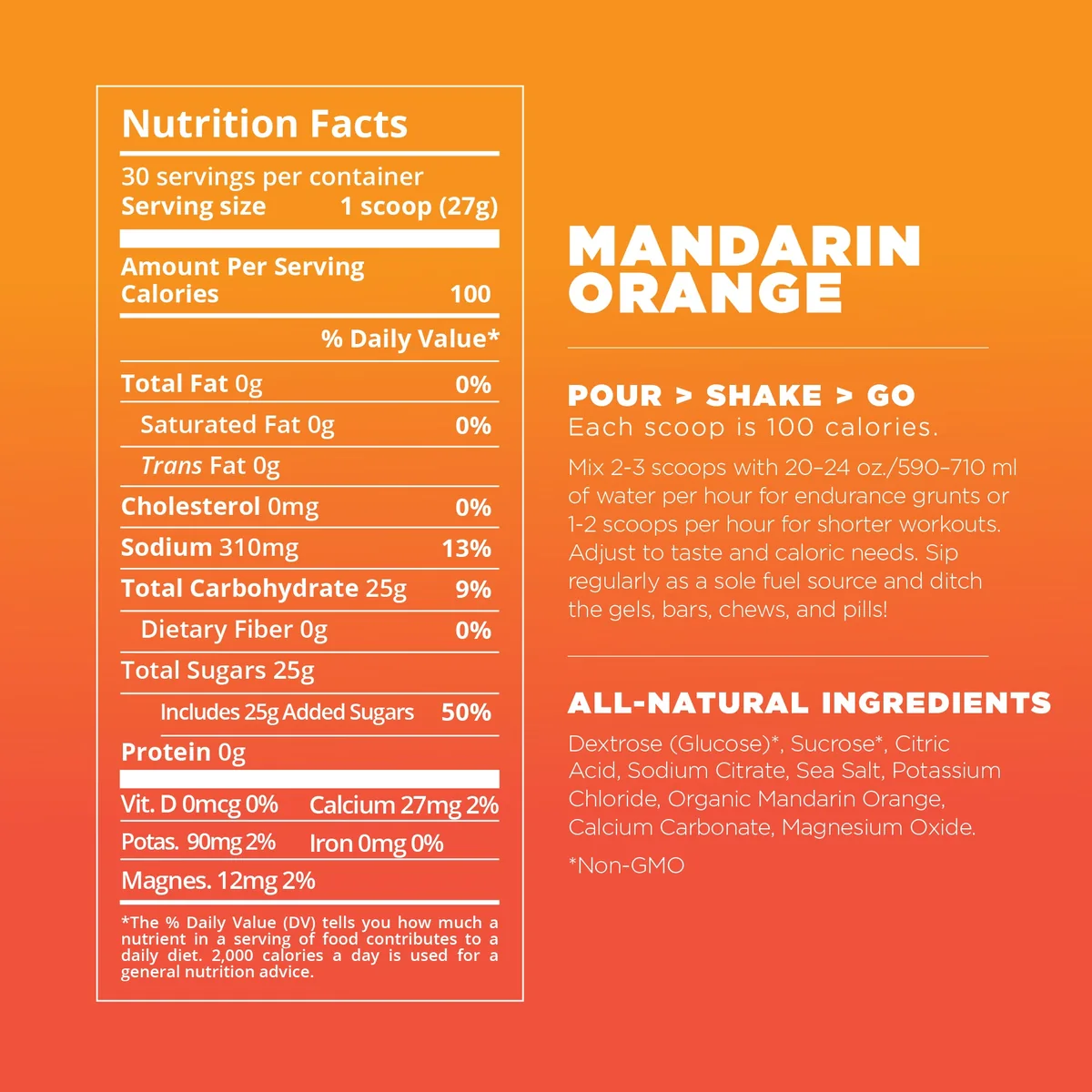
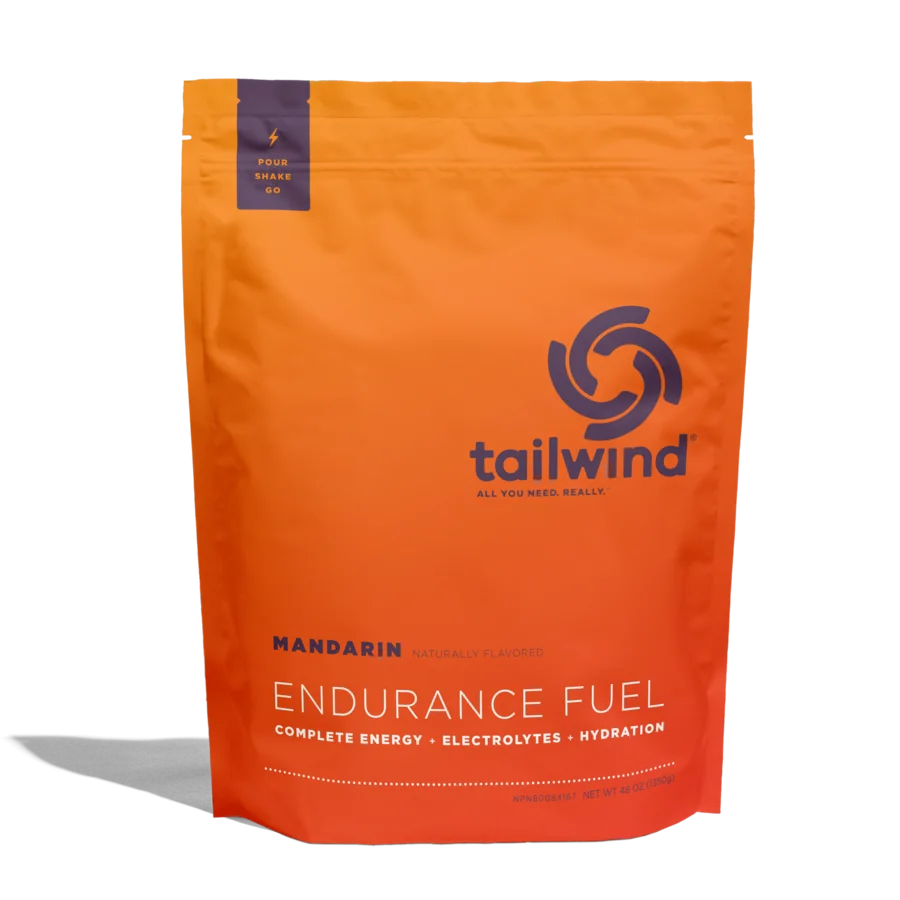
Here is the whole ingredient list of Tailwind Endurance Fuel, in order, as published on the bag:
Endurance Fuel, Mandarin Orange
Dextrose (Glucose), Sucrose, Citric Acid, Sodium Citrate, Sea Salt, Potassium Chloride, Organic Mandarin Orange, Calcium Carbonate, Magnesium Oxide.
Nine items. Both sugars are marked non GMO. Caffeinated flavors add organic caffeine, 35 mg per scoop.
Dextrose is glucose. Sucrose is table sugar, which is a glucose unit bonded to a fructose unit and split in the gut into both. So a scoop of this powder is not one sugar dressed up as two. It is glucose plus a second sugar that travels by a separate route, which is precisely the arrangement the published guidance asks for when the hourly rate goes up.
Tailwind describes the same thing in its own words: the formula takes advantage of how our bodies absorb nutrients
, and its composition matches what the gut is made to absorb
. That is a claim. The ingredient list is the check on it, and the ingredient list holds up.
Two sugars, two routes through the intestinal wall
Route one. The two are carried across together and water follows them. This is the route that saturates near 60 g of carbohydrate an hour.
Route two, and it is separate. Fructose is the other half of every sucrose molecule. Loading it is where the headroom between 60 and 90 grams an hour comes from.
Dextrose and sucrose are the first two ingredients on the bag, so one scoop loads both routes. Route capacities from Jeukendrup 2014.
The salt is in the same bottle as the sugar, and that is not a coincidence
The reason oral rehydration solution works at all is not that it contains salt. It is that it contains salt and glucose together, because the two are carried across the intestinal wall in company and water follows them. The World Health Organization formulation that came out of that work is precise: 75 mmol per litre of glucose, 75 mEq per litre of sodium, 245 mOsm per litre in total.
An endurance drink is not a rehydration salt and should not pretend to be one. It carries far more carbohydrate, because its job is fuel. But the co-transport principle is the same, and it is why Tailwind claims its fuel maximizes your absorption of water, more than if you were to drink water alone
, and why it describes fuel, electrolytes and water together as having a synergistic effect, allowing the body to absorb more of each
.
Run the arithmetic on their own mixing instructions and you can see where the bottle actually sits. Two to three scoops in 20 to 24 ounces of water, which is 620 to 930 mg of sodium in 590 to 710 millilitres:
Sodium in the bottle, across Tailwind's own dosing range
Computed from the label: 310 mg of sodium per scoop, 2 to 3 scoops in 590 to 710 ml. The weakest mix on the bag is half the sodium of a rehydration solution. The strongest is close to it, with roughly ten times the carbohydrate, because it is a fuel and not a medicine.
That range is the point, and it is the thing a powder can do that a sealed sachet cannot. You are holding the dial. If the day is cool and short you mix it weak. If you sweat salt and the day is long you mix it strong. If your stomach starts complaining at hour five you add water to the same bottle and keep drinking, which is not an option a gel gives you.
Zero grams of everything else
The nutrition panel has a column of zeros that most people scroll past. Zero fat. Zero fiber. Zero protein. On a supermarket shelf that column would read as a weakness. At hour six of a hot race it is most of the value.
Protein in particular is a live argument in this category, and Tailwind takes a position on it in public rather than in a footnote:
Protein during exercise doesn't improve endurance, but it does correlate with GI distress. Studies show no significant endurance difference between carb-only and carb-protein drinks. Protein is a complex molecule that is hard to digest, potentially shutting down your digestive tract during exercise and causing stomach issues. Tailwind Nutrition, science page
You do not have to accept that verdict to notice what it costs them to publish it. The same company sells a Recovery Mix with 20 g of complete protein in it, for after. The argument is not that protein is bad. It is that protein during the effort is a molecule you are asking a demoted digestive tract to take apart while you are running, and that the return on it is small.
Part sixThe stacking problem: five products means five concentrations
Here is the fueling plan almost everyone actually runs. A drink mix in the bottle. Gels in the vest. Chews for when the gels get unbearable. Salt tablets because someone said to. Real food at aid stations. Five products, five different concentrations, taken on five different schedules, in a gut that is running at reduced capacity.
How many concentrations are you actually controlling?
The usual planDrink mix, gels, chews, salt tablets, aid station food
One product, sippedScoops per bottle, adjusted by you, mid effort
When hour four goes badly, the first plan has five suspects and no way to question any of them. The second has one number, and changing it teaches you something for next time.
Nobody controls that. You cannot know what the combined concentration in your stomach is at any moment, because you never measured any of the inputs and they arrive on top of each other. When it goes wrong, you also cannot tell which one did it, so next time you change all five.
Tailwind's answer is printed on the back of the bag, next to the mixing instructions, and it is blunter than most brands would ever put in print:
Sip regularly as a sole fuel source and ditch the gels, bars, chews, and pills. Printed on the Endurance Fuel package, beside the nutrition panel
Their own FAQ carries the same instruction and adds the honest caveat: Endurance Fuel is designed to be your only fuel source but we get it if you want to mix it up. When taking in other foods along with Tailwind, make sure to account for the additional calories to keep your gut happy.
That is the actual discipline. Not purity, arithmetic. One product means one concentration, one schedule, one number to adjust when something feels wrong. If hour four goes badly you have exactly one dial to turn, and turning it tells you something.
Part sevenOne in four reviewers brings up their stomach without being asked
Tailwind publishes its customer reviews openly. The review form asks for a rating, a title, a comment, and a few questions about what sport you do and how many hours a week you train. It does not ask about your stomach.
We read every Endurance Fuel review published on tailwindnutrition.com over the last three years, 1,621 of them, and counted how many raise the gut anyway. Their page counts 4,086 in total, which reaches further back than the window we read.
Endurance Fuel reviews mentioning the stomach, gut, nausea, bloating or digestion
409 of 1,621
25.2 percent. The subject is nowhere in the questions they are asked.
One hundred squares, one for every sixteen reviews. Twenty five of them are lit.
The reviews themselves are more specific than any brand copy would dare be. These are published on the product page, and they are quoted here as written.
★★★★★
Usually my stomach gets pretty acidic and I get nauseated on my long runs when I use just gels. This worked great without leaving me feeling heavy or making my stomach fee like a fire pit.
Stephanie, August 14, 2023, on tailwindnutrition.com
★★★★★
Love no longer having to carry gels or chews as this contains calories to make that additional item now worthless. NO gut bombs since using.
Vicky, September 15, 2023, on tailwindnutrition.com
★★★★★
The naked flavor makes getting your calories in easily without having stomach issues. The 200 calories make it also ready to track what you’ve had and where you are at from your consumption standpoint.
Patrick K., May 29, 2024, on tailwindnutrition.com
★★★★★
Only recently have I appreciated that Tailwind can be the whole (or 90% of the) fueling and electrolyte strategy. It doesn’t bother my stomach, it has enough calories, the complete electrolyte profile is great, the caffeine is helpful, and the flavors are not too strong.
Cory N., December 17, 2023, on tailwindnutrition.com
And one that does not agree, because a page that only quotes the happy ones is not worth reading:
★★★☆☆
Tailwind does seem to help prevent bonking and gives me that extra oomph I need toward the end of my runs. But I don’t feel good about putting the ingredients in my body - I would prefer something that felt more like whole real foods but perhaps that is just not possible with the digestion requirements of long endurance efforts.
Adam S., February 5, 2024, three stars, on tailwindnutrition.com
He answers himself in the last clause, and he is right to be uneasy about it. Twenty five grams of sugar per scoop is fifty percent of a day's added sugar allowance, and the label says so. The trade is deliberate: simple sugars are what a working gut can move fastest, which is the entire reason they are there and the entire reason nobody should be drinking this on the sofa.
Across those 1,621 reviews the average rating is 4.9 out of 5, which is exactly what Tailwind reports across all 4,086. Ninety eight percent of reviewers say they would recommend it.
Single serving $2.75, 30 servings $30.99, 50 servings $42.99. Seven flavors plus unflavored, two of them caffeinated.
Part eightIt started with a head in a trashcan
Tailwind is not a laboratory that decided to enter sports nutrition. It is a company founded in 2012 in Durango, Colorado by someone who blew up at a bike race. The story is on their own site, under a page title that reads From blowing chunks to happy ending:
I had never raced a mile in my life. So naturally, I signed up for the Leadville 100 MTB. Fast forward 10 hours: cramped, uncomfortable and questioning every life choice I'd ever made, I crossed the finish line and promptly headed for a trashcan where I purged the muesli that had been waging war on my stomach since the starting gun. Jeff, founder and CEO, Tailwind Nutrition story page
The line that follows it is the better one: Because endurance sports take guts. Let's give ours what they need to run smoothly.
Fourteen years later the same sentence is still the product brief.
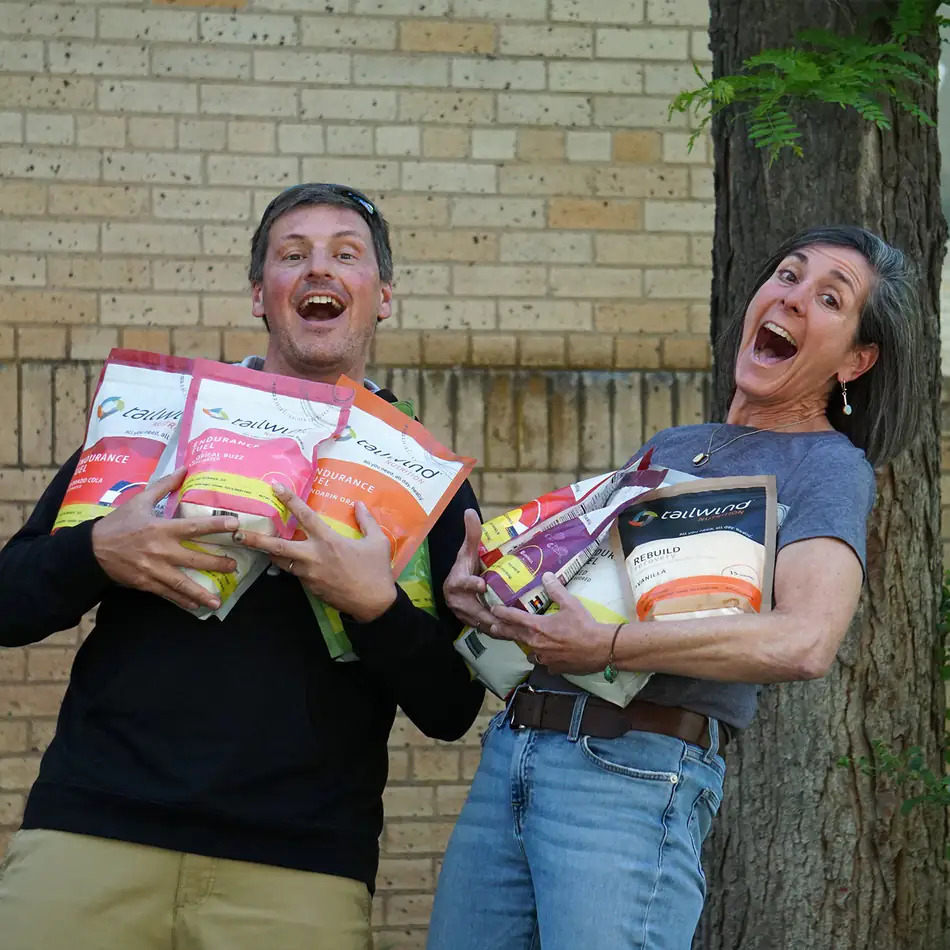
The Durango part is not decoration either. Their site states that Tailwind is manufactured there, and that staff test the products on the singletrack and in the San Juan Mountains outside the door. The footer of every page on their site says the same six words: Made by athletes in Durango, Colorado.
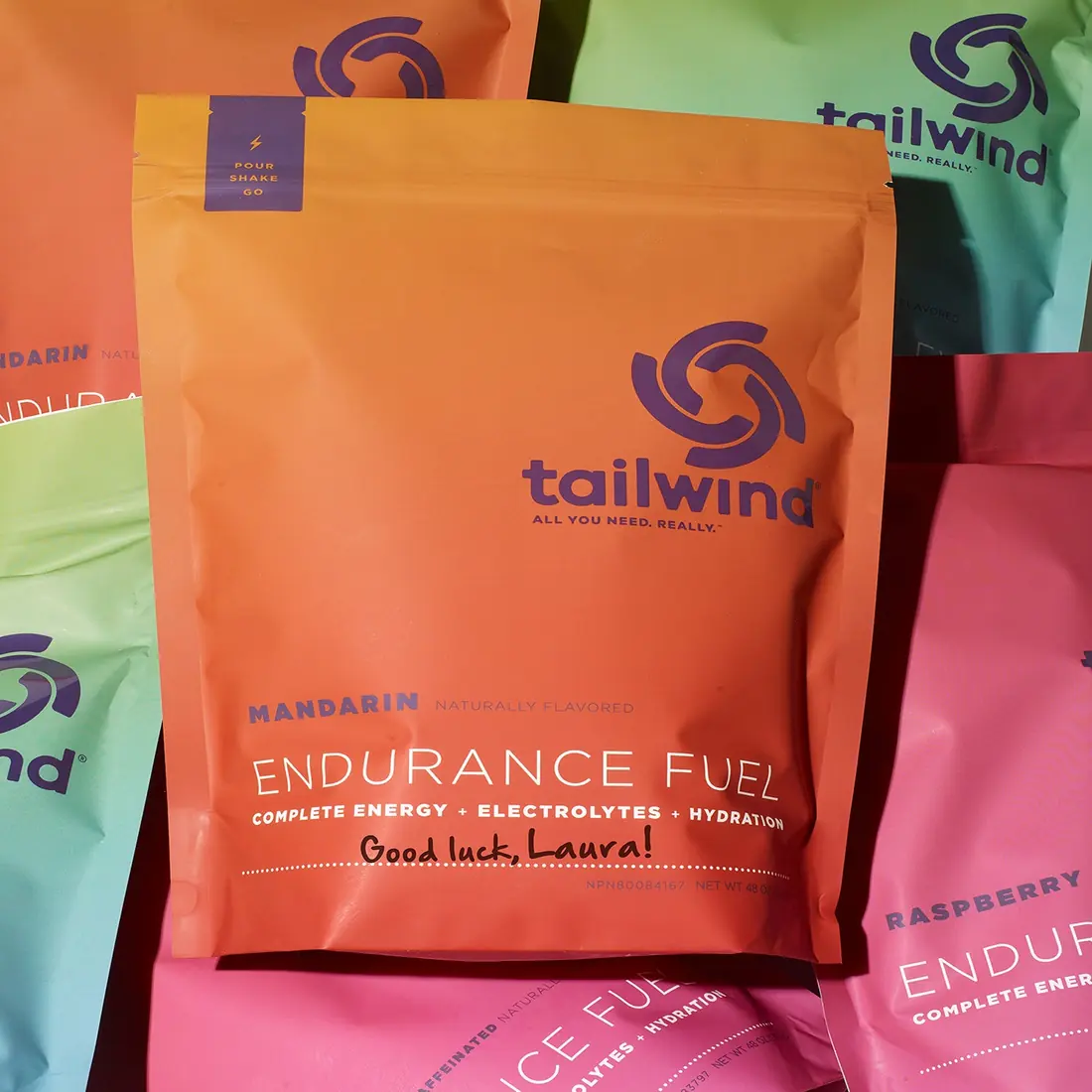
It shows up in small places. Orders leave with a name written on the bag in marker. One reviewer mentions it in passing while reviewing the powder: my name hand written on the package was kind of fun, too
. That is not a growth tactic. That is a small company still packing its own boxes.

How to actually run it
Everything below is Tailwind's own published instruction, converted into the units you will be thinking in at the aid station. Nothing here is invented.
| Effort | Per hour | Carbs / sodium |
|---|---|---|
| Shorter or easier session under about two hours | 1 to 2 scoops | 25 to 50 g 310 to 620 mg |
| Long ride or long run Tailwind's stated endurance dose | 2 to 3 scoops in 20 to 24 oz | 50 to 75 g 620 to 930 mg |
| Hot day, salty sweater | Same mix, more water alongside | Add water, not tablets |
| Hydration pack | Scoops for the whole planned duration | Or carry a concentrate and drink water with it |
Four things in that table are worth saying out loud, because each one is a place people go wrong.
Sip, do not dose
The label says sip regularly. The mechanism behind that instruction is on their science page: Sipping Tailwind provides steady, small doses of fuel that pass right through the stomach.
A bottle taken in three large gulps at the aid station is a different physiological event from the same bottle taken in twenty small ones, even though the totals match.

Do not add salt tablets on top
Tailwind is explicit that this is unnecessary and that it is the wrong lever: Endurance Fuel is meant to be used as a standalone product as each scoop contains 310mg (620mg per packet) of sodium which should be enough, even for salty sweaters. We recommend increasing your liquid intake on hot days instead.
Adding a tablet raises the concentration in a gut that is already struggling, which is precisely the mistake this whole page is about.
Start with unflavored if flavor fatigue is your failure mode
The Naked version exists for people who cannot face another sweet drink at hour seven, and for anyone who wants to add calories to something else without turning it into fruit punch. It carries the same 100 calories and 310 mg of sodium per scoop.
Caffeine is a scoop level decision, not a separate product
The caffeinated flavors carry 35 mg per scoop, 70 mg per single serving packet. That means you time caffeine by choosing which bag you scoop from, rather than by carrying a second thing that has its own concentration and its own timing.
The four rules, in one place
1. Sip continuously, do not dose at aid stations.
2. Adjust with water, never with a salt tablet.
3. Unflavored exists for hour seven. Use it.
4. Caffeine is a choice of bag, not a sixth product.
Where to start
The cheapest honest test is one long session. Buy single servings in two or three flavors, run your normal long day on nothing else, and see whether the thing you have been calling a weak stomach was actually a concentration problem wearing a disguise.
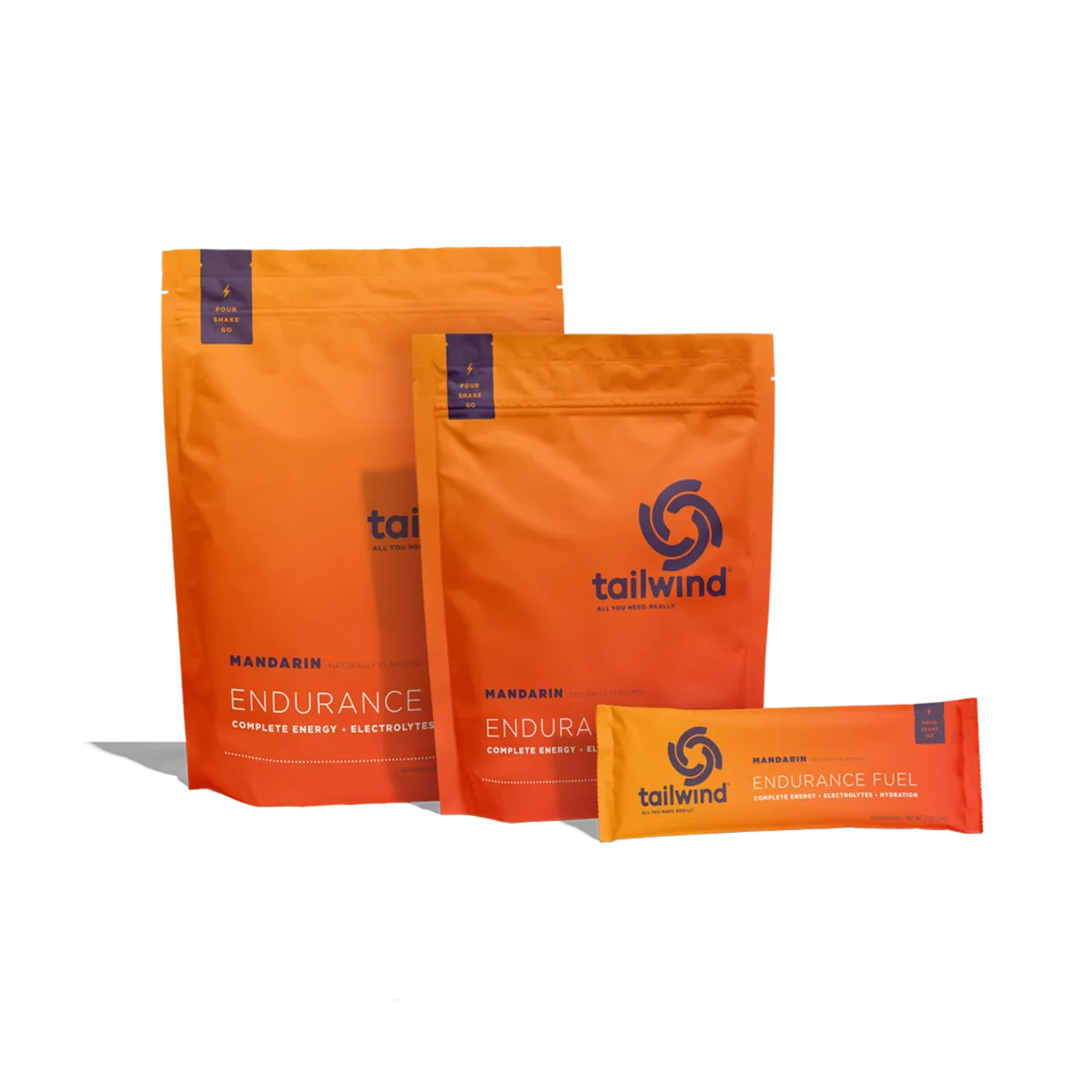
| Endurance Fuel, single serving 2 scoops, 200 calories, 620 mg sodium | $2.75 |
| Single serving 12 pack | $32.99 |
| 30 servings | $30.99 |
| 50 servings about 86 cents a scoop | $42.99 |
| High Carb Fuel 90 g of carbohydrate a serving, 2:1 glucose to fructose | from $58.99 |
Free shipping starts at $59 in the United States, which their own site announces in the bar at the top of every page. If you would rather try the range than the one product, the Welcome Bundle pairs the fuel with the recovery mix and a bottle.
Or look at the Welcome Bundle, the High Carb Fuel, or read their own account of the science.

Sources
- Stuempfle KJ, Hoffman MD. Gastrointestinal distress is common during a 161-km ultramarathon. Journal of Sports Sciences, 2015;33(17):1814-21. doi:10.1080/02640414.2015.1012104. Source of the 96.0, 60.3, 43.9 and 35.6 percent figures and of the 272 respondent sample.
- Jeukendrup A. A step towards personalized sports nutrition: carbohydrate intake during exercise. Sports Medicine, 2014;44(Suppl 1):S25-33. doi:10.1007/s40279-014-0148-z. Source of the 60 g/h and 90 g/h figures and of the quoted sentence on carbohydrate accumulating in the intestine.
- World Health Organization and UNICEF. Oral rehydration salts: production of the new ORS. WHO, 2006. who.int. Source of the 75 mmol/L glucose, 75 mEq/L sodium and 245 mOsm/L reduced osmolarity formulation.
- Tailwind Nutrition product page, Endurance Fuel. Nutrition panel, ingredient list, mixing instructions, FAQ answers and customer reviews, as published on August 20, 2026.
- Tailwind Nutrition, science page and story page. Quoted claims on absorption, gut tolerance, protein during exercise, High Carb Fuel, and the founder's account of the Leadville 100.
- Review counts: the 1,621 Endurance Fuel reviews published on tailwindnutrition.com between August 4, 2023 and August 17, 2026, read in full. 409 of them contain at least one of: stomach, gut, GI, nausea, nauseous, queasy, bloat, digest, tummy, belly, vomit, puke.